

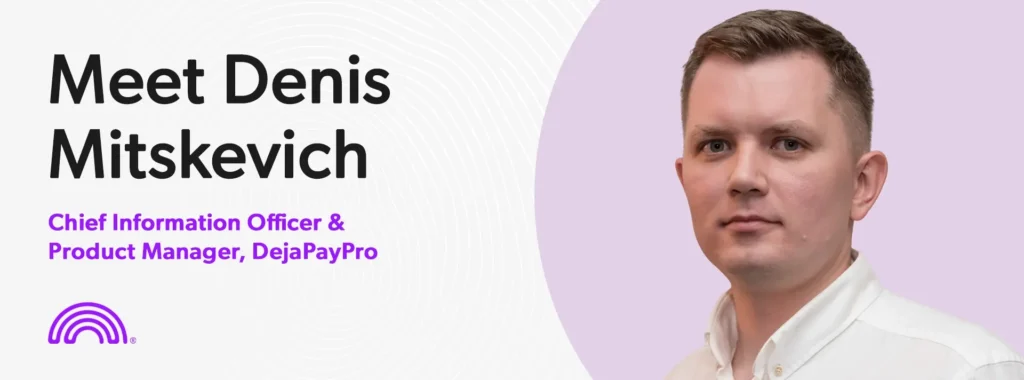
For more than a decade, Denis Mitskevich has helped shape many of the products that define Dejavoo today. As Chief Information Officer and Product Manager of DejaPayPro, he has played a key role in transforming what began as a simple payment application into a powerful point-of-sale solution designed for restaurants,
retailers, and growing businesses.
We sat down with Denis to learn how DejaPayPro came to life, how it has evolved over the years, and where it’s headed next.
How did DejaPayPro begin?
DejaPayPro’s story began in 2015 as a very simple application for entering payment amounts.
Before that, we had a mobile application for DeNovo, our back- office management system. We added a basic payment feature that connected to a payment terminal, allowing users to perform transactions like Sales, Returns, Voids, and Settlements.
Then an idea struck me.
Instead of manually entering the total amount, why not allow users to add individual items and have the application calculate the total automatically before processing the payment? It would eliminate
extra steps and make checkout much simpler.
Our iOS developer, Aleksey, built the first version of the idea, and we presented it to Dejavoo Founder and CEO, Mony Zenou, during one of his visits to our development team. He immediately saw the potential
and supported moving forward.
That moment became the beginning of DejaPayPro.
Who was the original target audience?
From the very beginning, our focus was on providing our partners with solutions for small restaurants and retail stores—what many people call “mom-and-pop” businesses.
These merchants are experts at running their businesses, not configuring technology. Our goal has always been to make their lives easier by delivering an all-in-one solution where the payment terminal and POS software work together seamlessly from a single provider.
We wanted technology that simply worked and was capable of growing sales, allowing business owners to focus on serving customers instead of managing systems.
What was the team like in the early days?
In the beginning, the team was small, and Mony was both our primary stakeholder and product visionary.
With decades of experience in the payments industry and a background in selling traditional cash registers, Mony had a deep understanding of the everyday challenges merchants faced. DejaPayPro became an opportunity to solve many of the limitations of older POS systems.
We talked almost every day.
Together, we reviewed feedback from agents and their merchants, researched the market, explored new ideas, and continuously refined the product. Many of the features used today started as simple conversations about real business problems.

How did DejaPayPro evolve?
Our next major challenge was inventory management.
We experimented with several approaches before realizing we needed a dedicated service to manage products and inventory efficiently. That decision became a turning point because inventory quickly evolved from an added feature into the foundation of the application.
Around the same time, we developed the Android version of DejaPayPro, expanding the platform even further.
By the end of 2017, we completed our first large-scale demonstration and deployed the register application to a significant group of merchants. By then, we also supported our first dedicated Android register with a built-in printer.
From there, DejaPayPro continued to grow alongside our hardware lineup. Every new device introduced new technical challenges, but each one also made the software stronger, more reliable, and more versatile.
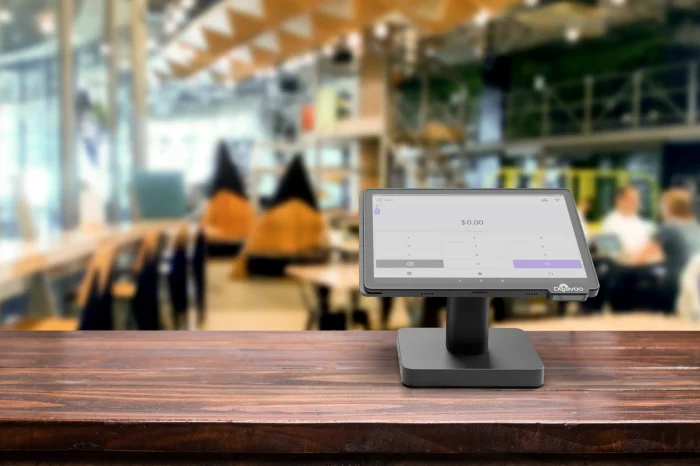
Since then, we’ve released multiple generations of POS hardware, including the D1 and the P18, and we’re already preparing support for our next generation of devices.
At the same time, DejaPayPro evolved alongside SPIn, Dejavoo’s integration platform that connects payment terminals with software applications.
What began as a simple payment calculator became a real-world showcase for what SPIn could do. As we solved challenges within our own product, we gained valuable insight that helped us improve the tools available to software developers.
That experience eventually led us to release developer tools that make it easier for third-party applications to integrate with Dejavoo payment terminals, followed later by direct integration capabilities on Android devices.
In many ways, DejaPayPro represents our vision for how payment integrations should work.
Rather than building features only for customers, we first solve the same challenges ourselves in a real product. That firsthand experience helps us build better software, create better developer tools, and ultimately deliver a better experience for merchants.
What does the future look like?
We’re working on an exciting new generation of features that will make DejaPayPro even easier to use.
Some of these are entirely new capabilities, while others are major enhancements to features we’ve refined over the years. Every improvement is focused on helping our partners and their merchants operate more efficiently and deliver a better customer experience.
“My goal is for DejaPayPro to become the entry point into the entire Dejavoo ecosystem.”
– Denis Mitskevich
“My goal is for DejaPayPro to become the entry point into the entire Dejavoo ecosystem.”
– Denis Mitskevich
Today, many businesses begin with a Dejavoo payment terminal and discover DejaPayPro later as they grow. I’d like to reverse that journey—have the industry choose DejaPayPro because it’s an outstanding POS solution, then naturally discover the broader Dejavoo ecosystem as their merchants’ businesses expand.
As someone with an engineering background, I also hope we continue bringing a little bit of engineering magic to our customers by making sophisticated technology feel simple.
If you are looking for the perfect POS payment solution for new restaurants and retail shops, check out DejaPayPro.